
Parts 1 and 2 of this series covered the problem instant payouts solves and how the product works. This post is about the factors that determine whether it gets built: what value does it bring to payment and software platforms?
The revenue math, and the assumptions behind it
A useful way to size the opportunity is per billion dollars of annual processing volume on your platform. At full ramp, a reasonable range is roughly $400,000–$500,000 in annual revenue per billion in processed volume, under a set of assumptions:
Around 40% of the eligible merchant base enrolls (enrollment is free, which is what makes this adoption rate achievable).
Enrolled merchants use instant payouts on roughly 15% of their annual volume, on average, which is close to one weekend a month.
The partner retains a margin in the ~75 basis point range on payout volume, without holding capital or credit risk.
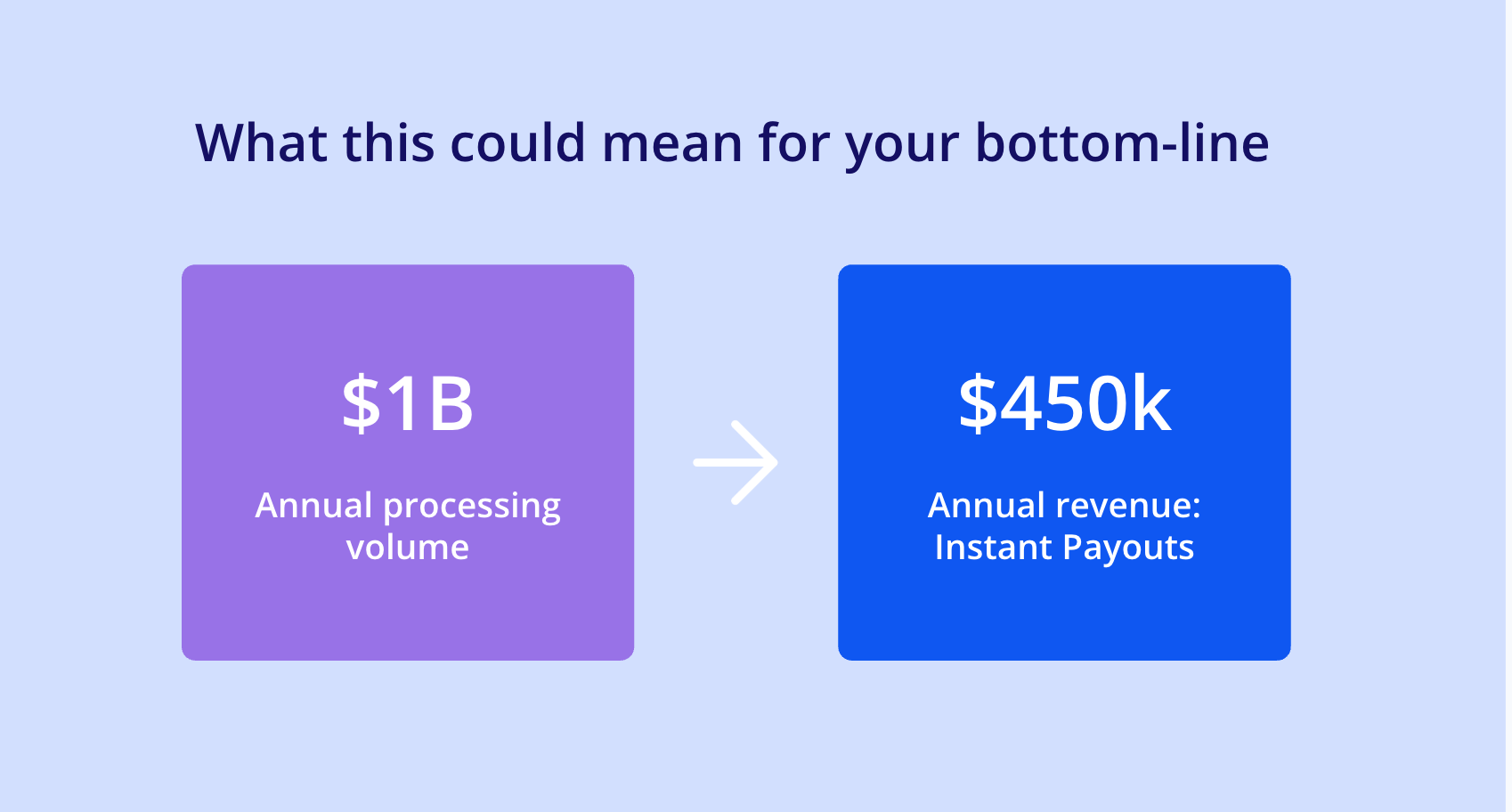
Two things to flag before you build this into a forecast. First, usage and adoption vary meaningfully by vertical; some merchant types (see below) run far above this average, and others run below it, so a portfolio-level blend matters more than a single average. Second, this figure describes a standard implementation where the provider holds the capital and risk; partners who choose to share risk or provide capital can negotiate a larger share of the fee revenue, but that's a different economic model with a different risk profile.
Retention and differentiation, not just a new revenue line
The revenue case is the easiest to model, but it's arguably not the main reason to add a liquidity product. Two second-order effects tend to matter more over time:
Retention. Merchants using multiple products from the same provider are measurably less likely to switch providers. A liquidity feature is one of the lowest-friction ways to get a merchant using a second product, because enrollment is free and the value is immediate and obvious.
Differentiation. As faster access to funds becomes table stakes, payment companies that can't offer it are competing on price and service alone. Payment companies that can offer it, especially with same-day usability on weekends and holidays, have a concrete answer to "why should I stay with you" that doesn't depend on undercutting margin.
Where usage concentrates
Adoption isn't evenly distributed across merchant types. Verticals with recurring same-day payout obligations to a third party, most notably salons and other services businesses that pay independent contractors or booth renters, show dramatically higher usage than the SMB average; some run an instant payout on the majority of their daily volume as a matter of routine. If your portfolio has vertical concentration in services, subcontracted labor, or gig-adjacent models, that's a signal the opportunity may run well above the blended average.
What implementation actually takes
The typical build-to-launch path breaks into a few phases:
Data integration — sharing authorization and settlement data (often the same files or API feeds you already generate) so eligible merchants can be identified and offers personalized.
Front-end setup — a lightweight embed if you want the experience in your own portal, or a white-labeled hosted option if you'd rather skip the build.
Enrollment and marketing — inviting eligible merchants, either using a proven email sequence and cadence or running it yourself with a provided playbook.
Settlement account activation — updating the deposit account in the flow of funds, which can be done manually or programmatically.
Because most of the compliance, underwriting, and funding infrastructure already exists on the provider side, a realistic timeline from signed agreement to live product is measured in weeks, not quarters, with the heaviest lift typically being the initial data integration.
Where to start
If the numbers here are in the right neighborhood for your portfolio, the next useful step isn't a build decision, it's a portfolio review: a look at your actual merchant mix, volume, and vertical concentration to see what a realistic revenue and adoption range looks like for your specific book of business, not the industry average.
This post closes out our three-part series on instant payouts. If you missed them, catch up on Part 1: the liquidity gap and Part 2: how the product works.